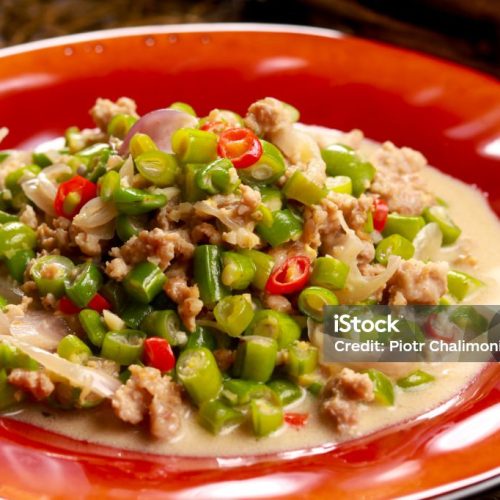
Gising gising
Ingredients
- 1 tablespoon canola oil
- 1 onion peeled and chopped
- 2 cloves garlic peeled and minced
- 1 pound ground pork
- 1 tablespoon shrimp paste
- 1 cup coconut milk
- Salt and pepper to taste
- 4 Thai chili peppers ends trimmed and minced
- 1 cup coconut cream
- 1 pound green beans ends trimmed and cut into ¼-inch thick
Instructions
- In a pan over medium heat, warm up the canola oil. Add onions and garlic, cooking until softened.
- Add ground pork, breaking it apart with the back of a spoon, and cook until lightly browned.
- Stir in shrimp paste and continue to cook, stirring occasionally, for about one minute.
- Pour in coconut milk and add chili peppers. Bring the mixture to a simmer.
- Reduce the heat and let it simmer for 8 to 10 minutes, or until the pork is cooked through, and the liquid is reduced.
- Add coconut cream and green beans, stirring to combine. Continue to cook for 3 to 5 minutes, or until green beans are tender yet crisp, and the sauce is reduced, beginning to render fat.
- Season with salt and pepper to taste. Serve hot.
Details Behind my Gising Gising Recipe
Gising Gising recipe – As stated by the recipe above, gising gising is a type of vegetable stew. However, there is more to the dish. Gising-gising is a tasty Filipino dish that comes from Nueva Ecija and Pampanga provinces. Also called ginataang sigarilyas, it’s a spicy vegetable soup with winged beans as the star. Cooked in coconut milk with labuyo chili, garlic, onions, and bagoong alamang, its name means “wake up, wake up.”
The key to this dish is the finely chopped winged beans, giving a delightful texture, and it includes garlic, ginger, onions, bagoong alamang, and siling haba and labuyo peppers for spice. Additionally, gising-gising commonly includes ground meat, typically pork, ground shrimp, or shredded tinapa (smoked fish), adding depth and richness to the dish.
Aside from this, gising-gising offers various tasty variations. Instead of winged beans, one can use chopped yardlong beans or water spinach (kangkong). It can also include seafood like squid, various vegetables, and spices. To personalize the taste, you can replace shrimp paste with bouillon cubes or meat and seafood stock.
Additional Notes for My Gising Gising Recipe
Cooking Gising-gising is a relatively quick and easy process, though chopping the vegetables can be a bit time-consuming. To streamline this, line up several beans on the cutting board, remove the stems, and cut them into the desired length all at once. When making the coconut sauce, maintain a gentle simmer to avoid curdling and separation—refrain from letting it reach a rolling boil for a smooth consistency. For a milder flavor, remove the seeds and veins from chili peppers before chopping.
The dish is best enjoyed as a main dish with steaming hot rice or as a flavorful side dish to grilled meat or fish. However, due to its milk content, it’s crucial to store any leftovers promptly. To prevent spoilage, refrigerate them in an airtight container for up to 3 days.
Dishes Similar to Gising Gising
Notably, gising-gising shares similarities with the Bicolano dish Bicol Express in terms of ingredients. What is Bicol Express? Also referred to as sinilihan, meaning spiced with chili, bicol express is a flavorful stew featuring pork and spices cooked in a coconut sauce. Originating from Bikol but gaining popularity in Malate, Manila, this dish showcases a mix of long and small chili peppers, coconut milk or cream, shrimp paste or stockfish, onion, pork, ginger, and garlic. Though the classic bicol express recipe features pork, it welcomes variations that include seafood and beef for those looking to explore diverse flavors.
If you want something less spicy but still features similar ingredients or cooking methods, there is ginataang gulay. Ginataang gulay is a type of stew, with one well-liked version being ginataang kalabasa. This stew features calabaza cooked in coconut milk with spices. While shrimp and yardlong beans are typical ingredients, other variations use pork and assorted vegetables. Popular vegetable choices for this dish include squash, eggplant, green beans, and okra.
Other Vegetable Dishes
Generally, there is a variety of dishes that include coconut milk in the cooking process. One vegetable dish that includes this is laing. Laing is a vegetable dish originating from the Bicol Region. It is made with taro leaves, meat or seafood, and rich coconut milk seasoned with chili, lemongrass, garlic, shallots, ginger, and shrimp paste. Locals often call it pinangat or ginataang laing. Typically, it is served as a vegetable side dish and adds a unique flavor to complement meat or fish dishes.
Another vegetable dish option you can try is ginisang sayote. Ginisang Sayote, or Sautéed Chayote, is a simple Filipino dish that showcases the versatility of the chayote vegetable. In this dish, chayote is sautéed with garlic, onion, and tomato, flavored with savory ground pork. It is usually served with steamed white rice and generally makes for a simple but flavorful dish to enjoy.
Overall, there is a variety of vegetable dishes to enjoy in Filipino cuisine and many of them are cooked in several different ways. If you want to explore other stew options, there is dinuguan among others.