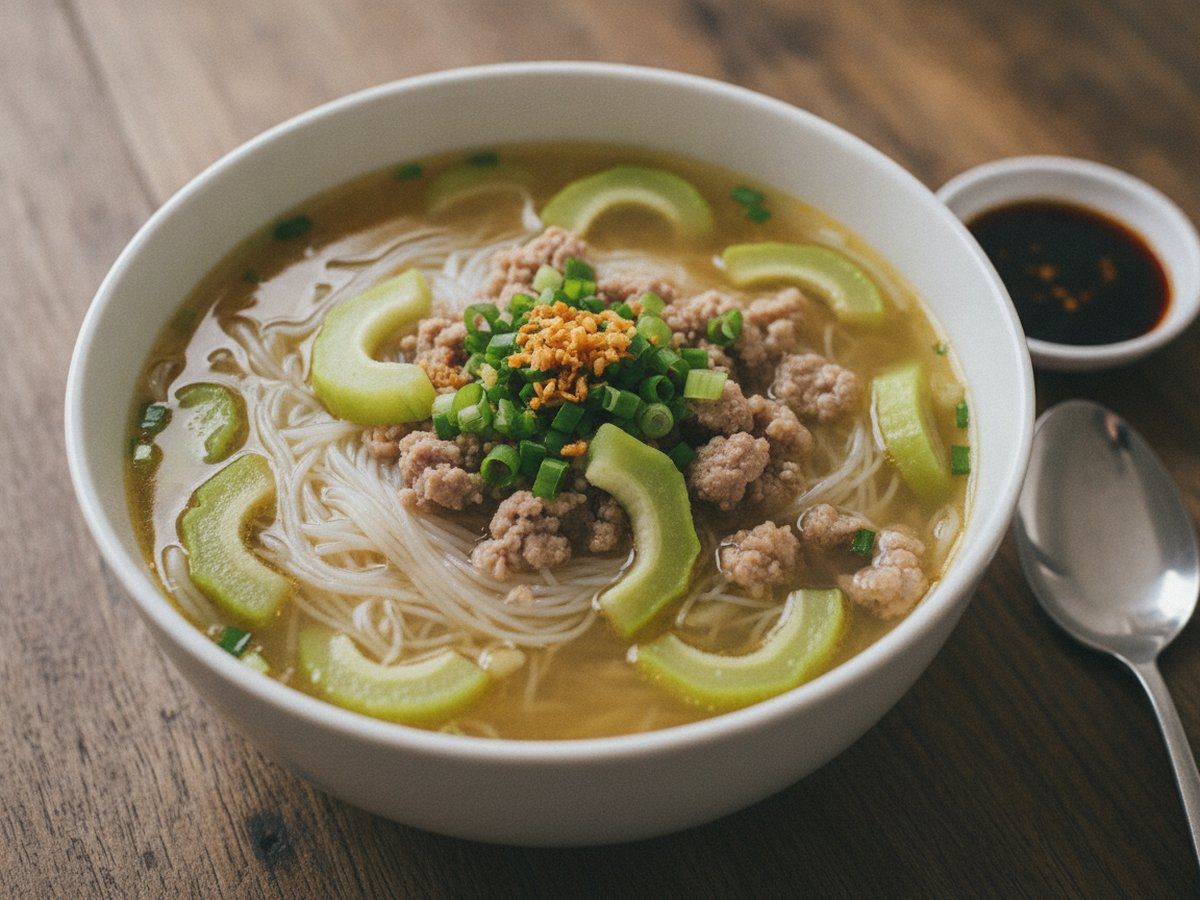
Ginisang sayote is sauteed chayote – the pale green, pear-shaped gourd – cooked with garlic, onion, tomato and a little ground pork until it is tender but still has bite. It is everyday Filipino home cooking rather than party food: cheap, quick, and eaten with rice. The part that catches people out is the sticky sap the raw gourd gives off when you cut it, and there is a simple trick for that.

Last updated
Recipe
Ginisang Sayote
Ingredients
Method
- Prepare the chayote
- Heat oil in a pan or wok over medium heat. Sauté onions and garlic until they're soft and release that amazing aroma.
- Toss in the sliced tomatoes and cook for 3-5 minutes until they become tender.
- Introduce the ground pork to the mix. Use a spoon to break it into smaller pieces. Cook until it's no longer pink. Then, add the fish sauce and let it cook for about another minute.
- Pour in the water, cover, and let it simmer for 3-5 minutes. Season with salt to taste.
- Add the sliced chayote to the pan, mixing everything together. Cover and cook for an additional 5 minutes or until the chayote is tender but still has a delightful crispness.
- Remove the pan from heat and transfer the dish to a serving plate.
Step by step, in pictures
Six moves, starting with the one the recipe card only calls “prepare the chayote”.
 Rub the cut ends together until the sap foams.
- Peel it, halve it, take out the seed.
- Soften the onion and garlic.
- Add the tomatoes and cook them down.
- Break up the pork and cook it through.
- Chayote last. Cover, about five minutes.


How to prepare sayote without the sticky sap
Cut half an inch off the top, then rub the cut-off piece against the cut face of the gourd in small circles. A white foam works its way out; keep going until it stops, then rinse it away. That foam is the sap, and getting it out first is what stops it gumming up your hands and your peeler.
Oil your hands before you peel if any is left – it lifts off skin far more easily than water does. Then peel with a vegetable peeler or a small knife, halve the gourd, cut out the soft seed in the middle, and slice.
The sap irritates some people’s skin, so if yours is sensitive, gloves are a simpler answer than the rubbing trick.
What is sayote?
Sayote is chayote, sold as choko in Australia and New Zealand and as mirliton in Louisiana. It is a pale green gourd shaped like a large pear, with one soft seed in the middle and a mild, faintly cucumber-like flavour that takes on whatever it is cooked with.
Botanically it is a fruit, though nobody treats it as one, and most of the plant is edible – leaves, shoots and flowers included. It is mostly water, which is why it cooks fast and why it collapses if you leave it on the heat. In a Filipino kitchen it stands in for green papaya, upo or courgette: it is one of the two standard options in tinola and in binakol.
What is ginisang sayote in English?
Sauteed chayote. Ginisa is the Filipino verb for frying something quickly in a little oil, almost always starting from garlic, onion and tomato – the base under a large part of the cuisine. So ginisang sayote is simply “sayote, done that way”, and the same construction gives you ginisang munggo, ginisang repolyo and the rest.
Getting the texture right
Chayote should still have some resistance when it reaches the table. It is watery and it collapses quickly, so it goes in last – after the pork is cooked through and the liquid is already simmering – and it wants about five minutes, not fifteen.
Cut the pieces to roughly the same thickness, or the thin ones will be mush before the thick ones give. Keep the lid on while it cooks: there is only a cup of water in the pan and the steam is doing most of the work.
Variations worth knowing
With carrot. Sliced carrot alongside the chayote is a common addition and lifts what is otherwise a very pale dish. Give it a head start – in with the tomatoes, not with the chayote.
With shrimp, or with no meat at all. Shrimp in place of pork is a standard swap, and the dish works meatless with the fish sauce carrying the seasoning. Some versions use oyster sauce instead of fish sauce, which finishes rounder and slightly sweeter.
With egg. Beaten egg stirred through at the end is another common variation, and the cheapest way to turn it from a side dish into a main.
Storing and reheating it
Cool it completely, then refrigerate it in a container with a tight lid. FoodSafety.gov puts cooked meat leftovers at 3 to 4 days in the fridge, and USDA guidance is to reheat them to 165 °F (74 °C), or to a rolling boil, before serving.
It does not freeze well. Chayote is largely water, and it thaws soft and watery rather than tender. Reheat in a pan rather than a microwave where you can, so the pork heats through evenly.
What to serve it with
Steamed rice, and often a fried or grilled fish beside it – despite the pork this reads as a side dish as much as a main. For other everyday Filipino vegetable dishes there is pinakbet, law-uy and gising gising, and for another quick pan dish of vegetables and shellfish, suam na mais.
Ginisang sayote FAQ
What is ginisang sayote called in English? Sauteed chayote. The vegetable is also sold as choko or mirliton depending on where you are.
What are the ingredients in ginisang sayote? Chayote, garlic, onion, tomato, ground pork, fish sauce, oil and a little water. The full list with amounts is in the card above.
What is the best way to cook sayote? Quickly. It is watery and mild, so it suits sauteing and short simmering, where it picks up flavour from what it is cooked with and keeps some bite. Long cooking turns it to mush.
Is ginisang sayote good for a diet? Chayote is a low-calorie, high-water vegetable, so the dish is mostly vegetable by volume. What it actually adds up to depends on the pork, the oil and how much rice goes beside it. No nutrition figures have been calculated for this recipe, so this page does not give any.
Do I have to peel it? The skin is edible, but on a larger gourd it is tough and sometimes prickly, so it is usually peeled. Peel it for this dish.