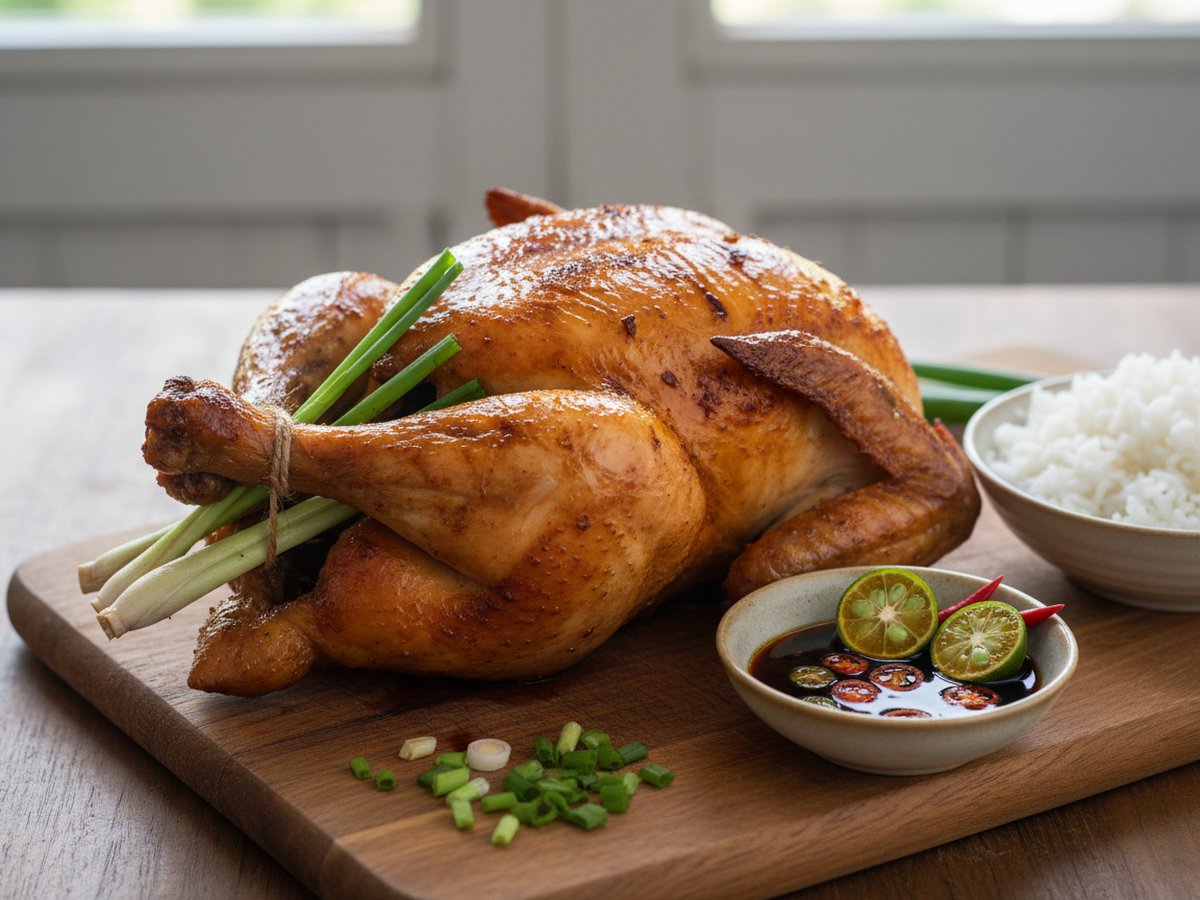
Lechon manok (Filipino roast chicken) is a whole chicken marinated overnight in soy sauce, calamansi juice and garlic, stuffed with lemongrass and roasted until the skin turns deep brown and glossy. It tastes salty, a little sour and a little sweet, with lemongrass running through the meat right to the bone.
Hands-on time is about 20 minutes and the roast takes about an hour. The real work is the marinade, which needs the night. Start it the day before and dinner is mostly waiting.
Last updated
Recipe
Lechon Manok (Filipino Lemongrass Roast Chicken)
Ingredients
Chicken
Marinade
For the cavity
Method
- Stir the soy sauce, calamansi juice, garlic, ginger, onion, sugar, salt and pepper together in a bowl until the sugar dissolves.
- Pat the chicken dry and put it in a large resealable bag. Pour in the marinade, press out the air, seal, and massage it over the whole bird. Refrigerate at least 4 hours, best overnight, turning the bag once or twice.
- Take the chicken out of the fridge 30 minutes before roasting. Lift it out of the bag and pour the marinade into a small pan. Push the bruised lemongrass and a few onion slices from the marinade into the cavity. Tie the legs together and tuck the wing tips under.
- Heat the oven to 180 to 200°C (350 to 400°F). Set the chicken breast-up on a rack over a foil-lined tray.
- Boil the reserved marinade for 3 to 5 minutes, because it has held raw chicken. Roast the chicken for about 1 hour, basting with the boiled marinade every 20 minutes. If the skin darkens too fast, lay a sheet of foil loosely on top.
- Check the thickest part of the thigh: it is done at 74°C (165°F), with clear juices. Rest the chicken for 15 to 20 minutes, then chop it and serve with rice and a dipping sauce.
What is lechon manok?
Lechon manok is a Filipino dish: a whole chicken, marinated and roasted, usually on a spit over charcoal. In the Philippines it is sold whole or chopped from roadside rotisserie stalls, ready to take home with rice.
The name is two words. Manok is Tagalog for chicken. Lechon comes from the Spanish lechón, a suckling pig. In the Philippines the word belongs to whole roast pork, and lechon manok borrows it for chicken.
Lechon manok vs lechon: what is the difference?
Lechon on its own means a whole roast pig, the centrepiece of a Filipino fiesta. Lechon manok is chicken, cooked the same way on a smaller scale: whole, seasoned from the inside, and roasted until the skin is the best part.
The flavour is different too. Pork lechon leans on salt and the crackling. Lechon manok carries a soy and citrus marinade, so the meat itself is seasoned, not just the skin.
Lechon manok ingredients
Every recipe behind this card agrees on the core: a whole chicken, soy sauce, garlic, lemongrass, salt and pepper, with something sour and something sweet. The rest is where cooks differ.
- Whole chicken. About 1 to 1.2 kg (2 to 2½ lb). A bigger bird works; it just needs longer in the oven.
- Soy sauce. Half a cup. It does the salting and most of the colour.
- Calamansi juice. A quarter cup. Calamansi is a small, very sour Philippine lime. Lemon or lime juice is a fine swap.
- Lemongrass (tanglad). Two stalks, bruised with the back of a knife and pushed into the cavity. This is the smell of lechon manok, so do not skip it.
- Garlic, ginger and onion. Crushed, minced and sliced, straight into the marinade.
- Sugar. One tablespoon, white or brown. It helps the skin brown and rounds off the soy.
The sources split on a few amounts. Garlic runs from 4 cloves (Slurrp) to 8 (Foxy Folksy); this card takes 6, the middle, which is also what Simple Comfort Food uses. Soy sauce is half a cup in both Foxy Folksy and NutriAsia, and calamansi is a quarter cup in NutriAsia, Slurrp and River Ten Kitchen.
How to marinate lechon manok
Marinate lechon manok overnight in the fridge, in a sealed bag, and turn the bag once or twice. Every recipe behind this card uses an overnight marinade or longer.
The minimum is a few hours. Slurrp says at least 4, Foxy Folksy at least 6. At the other end, River Ten Kitchen goes 24 to 48 hours. Under 4 hours, the flavour stays on the skin and the breast tastes like plain roast chicken.
A bag beats a bowl. Press the air out and the marinade wraps the whole bird, so you need far less of it.
Oven temperature and time
Roast lechon manok at 180 to 200°C (350 to 400°F) for about an hour, until the thickest part of the thigh reads 74°C (165°F). The sources do not agree on one temperature: NutriAsia roasts at 350°F, Slurrp at 375°F, Foxy Folksy at 400°F, and River Ten Kitchen starts at 400°F and drops to 350°F.
Pick the hotter end if your skin is pale at the 40-minute mark. Pick the lower end if the sugar in the marinade is darkening fast. Soy and sugar burn before plain skin does, so watch the wing tips.
The time is a guide. A 1 kg bird is usually done in about an hour; a larger one can take up to 1½ hours. The thermometer decides, not the clock.
No rotisserie? Oven, turbo broiler or spit
An ordinary oven is enough. Set the chicken on a rack over a foil-lined tray so the hot air reaches the underside and the drippings do not burn onto your pan.
A turbo broiler or an oven with a rotisserie spit gets you closer to the stall version, because the bird turns and bastes itself. Foxy Folksy uses an oven rotisserie; Panlasang Pinoy spit-roasts over charcoal for 2½ to 3 hours. Over coals, go by the thermometer, not the clock.
How to tell lechon manok is done
It is done when a thermometer in the thickest part of the thigh, away from the bone, reads 74°C (165°F). That is the safe temperature for chicken, and the number does not bend.
Without a thermometer, cut between the leg and the breast. The juices should run clear, with no pink, and the leg should move loosely in its joint. Then rest it for 15 to 20 minutes before you cut it.
What to serve with lechon manok
Serve lechon manok with steamed white rice, a sour pickle and a sauce. The pickle is atchara, sweet-sour green papaya, which cuts the fat of the skin.
For the sauce, there are two camps. One is a thick, sweet liver sauce, the kind in this lechon sauce recipe. The other is toyomansi: soy sauce and calamansi, with chopped chili if you like heat. Toyomansi takes one minute and suits the citrus in the marinade.
If you like this, try chicken inasal next. It is grilled pieces rather than a whole bird, with a vinegar marinade and an annatto oil baste instead of soy.
Variations
- With lemon-lime soda. Panlasang Pinoy and NutriAsia both add 7-Up or a similar soda to the marinade, for sweetness. If you add it, leave out the sugar.
- With fish sauce and turmeric. Simple Comfort Food blends fish sauce, turmeric, ginger and lemongrass into a paste and rubs it on. The skin comes out more golden than brown.
- With bay leaves. Simple Comfort Food and Panlasang Pinoy both add a few dried bay leaves.
- With green onions in the cavity. Panlasang Pinoy stuffs a bunch of green onions in with the lemongrass. It is a good use for the tops you would otherwise throw away.
Make-ahead and leftovers
The make-ahead is built in: marinate the chicken the day before, and it goes straight from fridge to oven. Take it out about 30 minutes before roasting so the cold is off the meat.
Refrigerate leftovers within 2 hours and eat them within 3 to 4 days; that is the USDA guidance for cooked chicken. Reheat in a hot oven, not the microwave, if you want the skin to stay crisp.
The best use for leftovers is paksiw. Simmer the chopped chicken in vinegar, soy sauce, sugar and liver sauce, the same way as lechon paksiw made with leftover roast pork.
Questions people ask
Is lechon manok a Filipino dish?
Yes. Lechon manok is Filipino roast chicken, marinated in soy sauce, calamansi and garlic and stuffed with lemongrass, and sold whole from rotisserie stalls across the Philippines.
How long should I marinate lechon manok?
Overnight is best. At least 4 hours will work, and some cooks go 24 to 48 hours. Keep it in the fridge in a sealed bag the whole time.
What is the difference between lechon and lechon manok?
Lechon on its own is a whole roast pig. Lechon manok is a whole roast chicken cooked the same way, with a soy and citrus marinade that seasons the meat, not just the skin.
Can I make lechon manok without calamansi?
Yes. Use the same amount of lemon or lime juice. The marinade is a little less floral but just as sour.
How do I cook leftover lechon manok?
Turn it into paksiw: simmer the chopped chicken in vinegar, soy sauce, sugar and liver sauce until the sauce thickens. Or reheat it in a hot oven to keep the skin crisp.