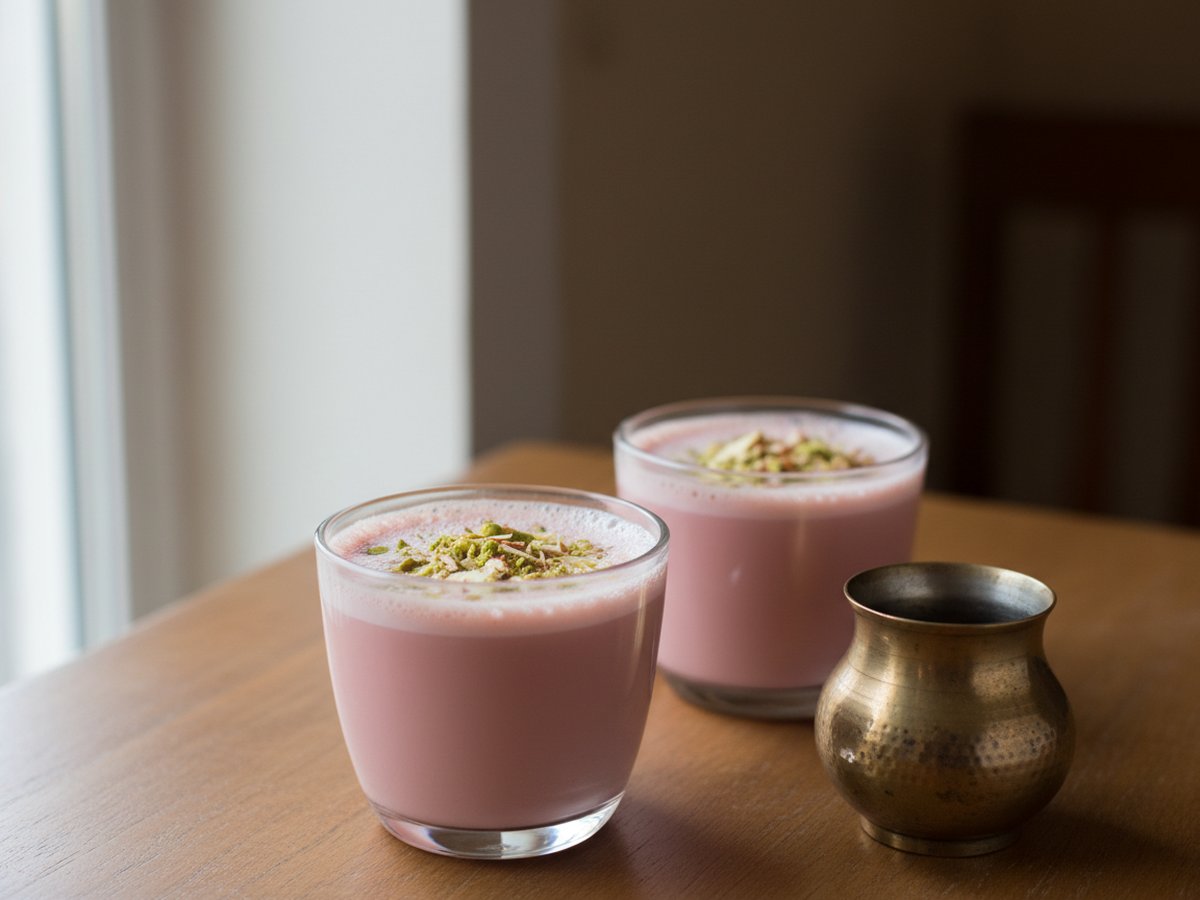
Ras malai is soft discs of fresh cheese soaked in sweetened milk that has been thickened with cardamom and saffron. The cheese is chenna, curdled out of whole milk with lemon juice and kneaded smooth. The milk it sits in is rabri. Everything else on the plate is a garnish.
Two routes to it are in wide use. The one below is the chenna method, which is the dish as it is defined: you make the cheese. Further down is the milk powder version that most Pakistani home cooks reach for on a weeknight, with its own quantities and an honest account of what it costs you.

Last updated
Recipe
Ras Malai
Ingredients
For the chenna
For the sugar syrup
For the rabri
Method
- Bring the 1 litre of milk to a boil in a heavy pan, then take it off the heat and let it settle for a minute.
- Add the lemon juice a spoonful at a time, stirring gently, until the curds pull away and the whey behind them runs thin and pale green.
- Pour through a muslin-lined colander, rinse the curds under cold running water, then gather the cloth and squeeze. Leave it to drain until it stops dripping.
- Tip the chenna onto a plate and knead it with the heel of your hand for 6 to 8 minutes, until it is smooth and you cannot feel any grain. Work in the semolina or cornflour now if you are using it.
- Divide into 12 portions. Roll each into a ball with no cracks in the surface, then press it into a disc about 1 cm thick.
- Bring the water and sugar to a rolling boil in a wide pan. Slide the discs in, put the lid on, and keep the heat high for 10 to 12 minutes. Do not lift the lid to look.
- Lift the discs straight into a bowl of cold water and leave them there for 30 minutes.
- Meanwhile simmer the 750 ml of milk with the sugar, crushed cardamom and saffron, stirring every few minutes, until it has reduced by about half.
- Press each disc gently between your palms to squeeze out the syrup, then slide them into the warm rabri so that every one is covered.
- Chill for at least 5 hours, overnight if you can. Serve cold, scattered with the pistachios and almonds.
What ras malai is made of
Four things: chenna, sugar syrup, rabri and nuts. Chenna is fresh cheese curdled from whole milk with an acid, usually lemon juice or vinegar. The syrup is water and sugar, and it exists only to poach the cheese discs so they swell. Rabri is whole milk simmered down with sugar, cardamom and saffron until it is thick enough to coat a spoon. The pistachios and almonds go on at the end.
Nothing in that list is hard to buy. The dish is difficult for one reason only, and it is the kneading.
What ras malai tastes like
Mildly sweet, milky and cool, with cardamom in the background and saffron just at the edge of what you can name. The texture is the point more than the flavour. A good disc gives way completely when you press it with a spoon and releases the milk it has been sitting in. A bad one is rubbery in the middle and tastes of nothing but sugar.
It is far less sweet than gulab jamun, which is its usual shelfmate. If you have eaten ras malai only from a tin, the homemade version will taste thinner and more of milk, and that is correct.
What ras malai is called in English
There is no English name in common use. Menus translate it descriptively, as cheese patties in sweetened milk or as milk cream dessert, but none of those is a real name and none of them is used by anyone who cooks it. The literal reading of the two words is useful though: ras is juice or syrup, malai is cream. The name describes the milk, not the cheese.
Is ras malai Pakistani or Bengali?
Both claims are honest, and the sources disagree. Wikipedia and Google’s own AI Overview place the origin in Bengal, in the eastern part of the subcontinent, and one of the recipe sites used here tags its cuisine as Bengali outright. The two Pakistani food blogs consulted tag the same dish as both Indian and Pakistani.
The sensible reading is that the dish originates in Bengal and has been a standard sweet-shop item across Pakistan for long enough that nobody there treats it as foreign. This page does not settle the question, because the sources do not.
The step that decides whether it works
Kneading the chenna is the whole recipe. You are not mixing; you are pushing the curd forward with the heel of your palm, gathering it back and doing it again, until the grain disappears and the mass turns smooth and slightly tacky. Six to eight minutes is the usual figure, though one source calls for ten and another for three to five.
Ignore the clock and go by the surface. Under-kneaded chenna stays visibly grainy and dry, and the discs made from it crack at the edges and fall apart in the syrup. Over-kneaded chenna starts to release fat and feels oily on your palm, and those discs come out dense. The window between the two is wide enough to hit on a first attempt, which is why the clock matters less than looking.
Why the discs must boil, not simmer
The syrup has to be at a rolling boil when the discs go in, and it has to stay there with the lid on. The discs roughly double in size, and they do that because steam is driving into them. Drop the heat to a simmer and they will sit there absorbing sugar without expanding, and you will get sweet rubber.
Published poaching times run from nine minutes to seventeen across the sources here. Ten to twelve is the middle of that and works for a 1 cm disc. Do not lift the lid during it. The cold water afterwards is not optional either: it stops the cooking and it is what lets the disc give up the syrup when you press it.
Ras malai, step by step
 Boil the milk, then take it off the heat.
- Add the lemon juice until the curds separate.
- Drain the curds in a cloth and squeeze.
- Knead the chenna smooth with the heel of your hand.
- Slide the discs into boiling syrup and cover.


Getting the rabri right
Simmer the milk down by about half, stirring often enough that nothing catches on the base. Add the sugar once it has come to a boil, and the saffron and cardamom towards the end so the aroma is still there when you serve it.
There is a limit worth knowing. If you reduce the milk too far it turns into a thick sauce, and a thick sauce cannot soak into the discs; they will sit on top of it instead of drinking it. The rabri should still pour. This is where the restaurant version and the home version genuinely part company, because a sweet shop wants a rabri that holds its shape in a display tray and you want one that disappears into the cheese overnight.
The quick milk powder version
You can skip the curdling entirely. Both Pakistani sources consulted here do, and the method is the same in each: mix about 1 cup (100 g) full-fat milk powder with a beaten egg, 1 1/2 to 2 tsp plain flour, 3/4 to 1 tsp baking powder and 2 tsp oil or ghee into a soft dough, roll it into discs and poach them in sweetened milk rather than syrup. One of the two builds the poaching milk from 4 1/2 cups whole milk plus a 12 oz can of evaporated milk; the other uses 3 to 3 1/2 cups whole milk with 1/3 cup (70 g) sugar.
It takes about an hour instead of an afternoon and it is genuinely good. What you lose is the texture: milk powder discs are cakier and more uniform, and they do not collapse under a spoon the way chenna does. They also taste of baking powder if you are heavy-handed with it. If you are making this for the first time, make it this way once to see what the finished dish should look like, then make the chenna version.
What goes wrong, and what it looks like
Discs that disintegrate in the syrup were under-kneaded, or the chenna was too wet. Squeeze harder next time and knead longer.
Discs that stay small and hard either went into syrup that was not boiling, or the lid came off. There is no rescue for these once they are cooked.
Chenna that will not come together and feels squeaky usually means too much acid, or acid added while the milk was still at a hard boil. Take the pan off the heat first, wait a minute, then add the lemon juice gradually and stop the moment the whey runs clear. Rinsing the curds under cold water washes out the leftover lemon, and skipping that rinse is what makes a batch taste faintly sour.
A skin on the rabri means it was not stirred often enough. Strain it and carry on; it does not ruin anything.
Storing ras malai
Keep it covered in the fridge and eat it within three to four days. It genuinely improves on day two, because the discs are still absorbing milk, so making it the day before you need it is the easier plan rather than the compromise.
It does not freeze. The chenna goes grainy on thawing and the milk splits. If you want to get ahead, poach the discs and keep them in their syrup for a day, then make the rabri fresh and combine the two a few hours before serving.
Serve it cold and in small bowls with plenty of the milk. If you are putting together a tray of sweets, it sits well next to date rolls, and a cup of Pakistani chocolate tea afterwards is not a traditional pairing but it is a very good one. For something in the same milk-and-cardamom family that needs no cooking at all, there is mango and condensed milk ice cream.
Hero photograph: Ras Malai 2 by Shaharbano, licensed CC BY-SA 4.0. The step illustrations are AlmostNordic’s own.
Questions people ask
Why did my ras malai turn hard?
Almost always under-kneaded chenna, or syrup that was not at a full boil when the discs went in. The discs need steam to expand; a simmer only makes them absorb sugar.
Can I use vinegar instead of lemon juice?
Yes. One of the sources here uses 2 tbsp white vinegar diluted with 2 tbsp water in place of the lemon juice. Rinse the curds under cold water either way, or the acid stays in the cheese.
How long does ras malai need to chill?
At least 5 hours, and overnight is better. The discs are still drinking the milk during that time, which is what gives them the texture.
Can I make ras malai without eggs?
The chenna method above has no egg in it at all. The quick milk powder version does use one beaten egg, so if you need it egg-free, make the chenna version.