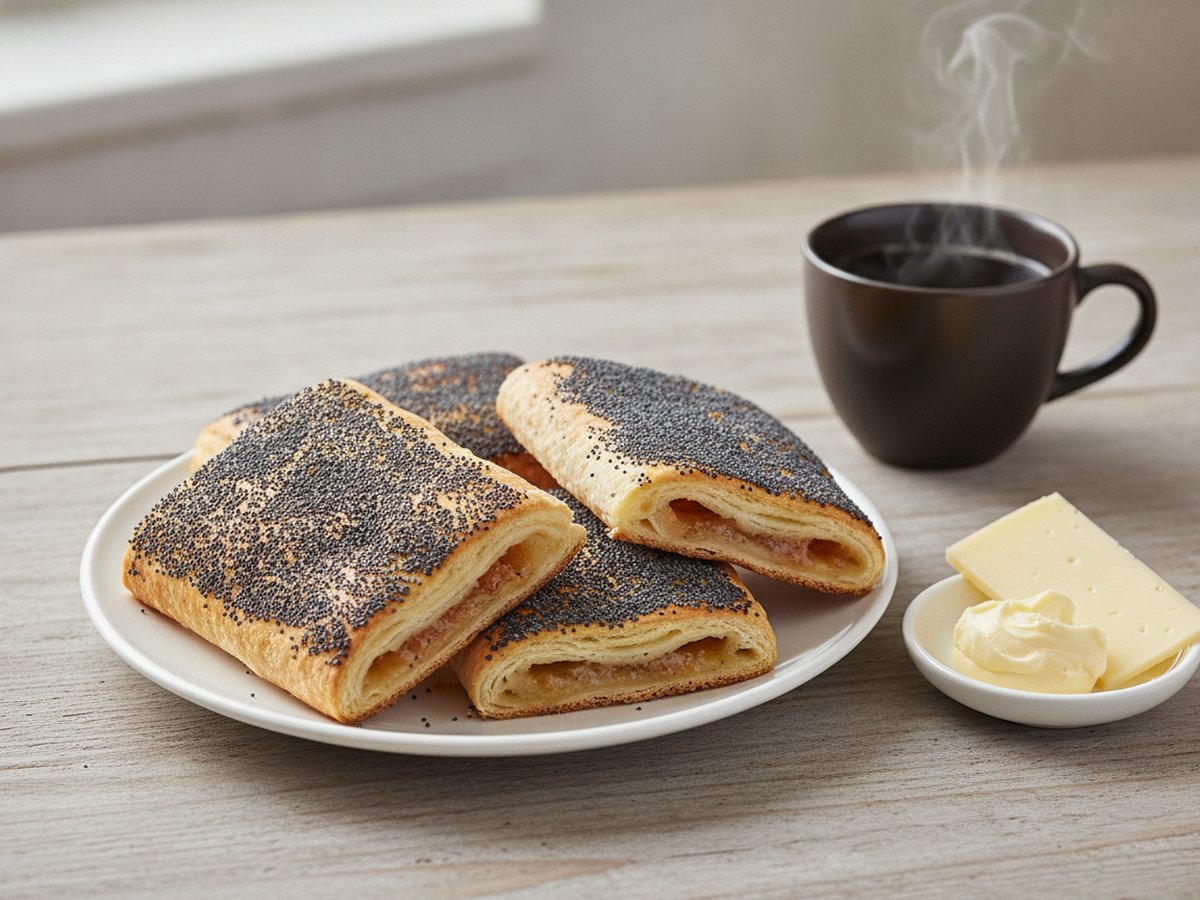
Tebirkes (roughly TAY-beer-kes) is the Danish poppy seed pastry: laminated yeast dough folded in three around a thin layer of remonce, a butter, sugar and marzipan filling, then cut into flat rectangles, covered in poppy seeds and baked until crisp. This recipe makes 12 and bakes in 20 minutes at 220°C (425°F); the work is in the dough, which needs three rounds of rolling and folding.
If you searched for “poppy seed danish”, this is almost certainly the pastry from the Danish bakery counter. It is not the Eastern European poppy seed roll, which is a sweet bread wrapped around a thick poppy seed filling. In tebirkes the poppy seeds sit on the outside, and the inside is butter and almond.
Last updated
Recipe
Tebirkes Recipe (Danish Poppy Seed Pastry)
Ingredients
Dough (Dobbernation)
Remonce filling
Topping
Method
- Mix the lukewarm water, yeast, egg, salt and sugar in a bowl. Stir in the flour, then knead on a lightly floured surface until smooth and elastic. Wrap and chill for 1 hour.
- Roll the dough to a square about 45 cm (18 in) across. Lay the cold butter slices in a square in the middle, turned 45 degrees so it sits like a diamond, then fold the corners of the dough over to close it in completely and pinch the seams.
- Roll into a long rectangle and fold it in three like a letter. Wrap and chill for 1 hour. Repeat the rolling and folding twice more, chilling for 15 minutes between rounds.
- Mash the marzipan, softened butter and sugar together into a smooth paste. Keep it at room temperature.
- Cut the dough in half and keep one half cold. Roll the other into a thin rectangle about 36 x 23 cm (14 x 9 in), roughly 3 mm thick. Spread half the remonce down the middle third, lengthways. Fold one long side over the filling, dab it with water, fold the other side over to overlap by about 2.5 cm (1 in) and press to seal. Repeat with the second half.
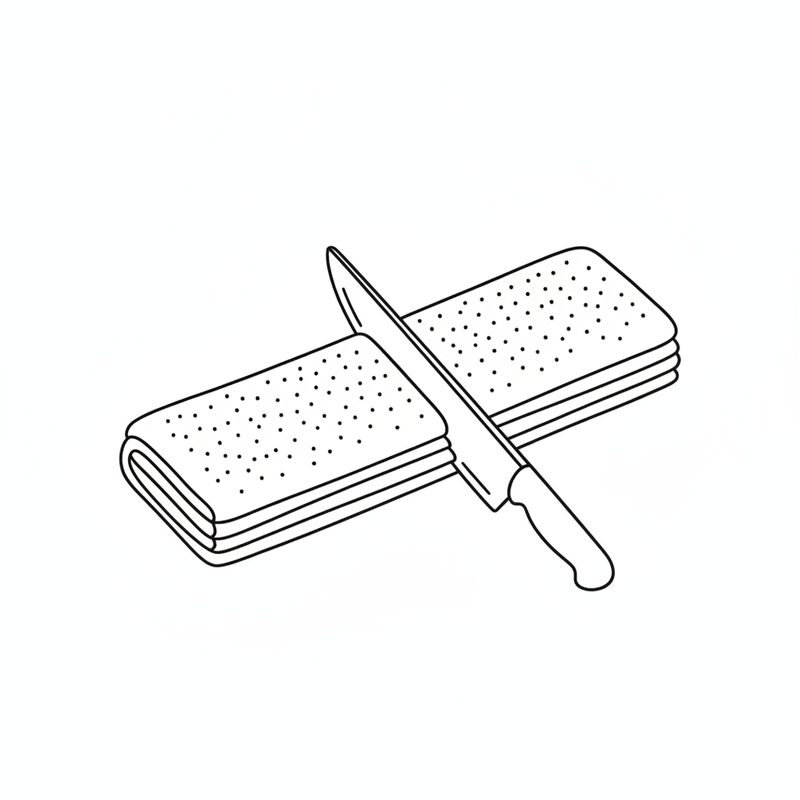
- Turn the strips seam side down. Brush with beaten egg and cover thickly with poppy seeds, then cut each strip across into 6 pieces. Set them on trays lined with baking paper.
- Cover and proof somewhere cool until roughly doubled and wobbly when the tray is nudged, about 2 hours (Dobbernation proofs for 30 minutes in the fridge instead).
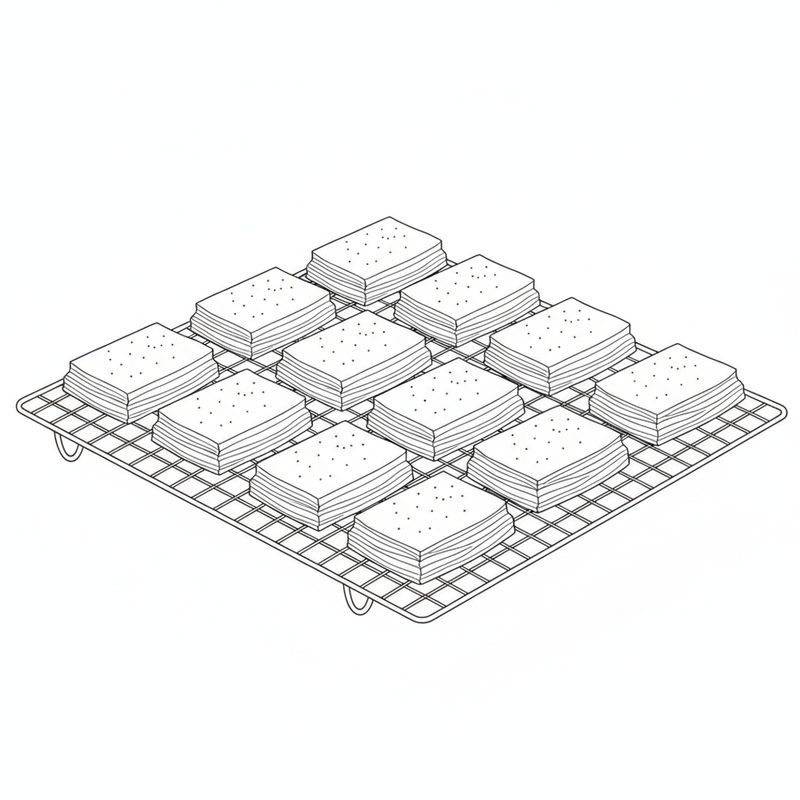
- Bake at 220°C (425°F) for about 20 minutes, until deep golden (Dobbernation lowers the oven to 200°C / 400°F after the first 5 minutes; Skandibaking bakes at 190°C fan). Cool on a rack.
What is tebirkes?
Tebirkes is a flat, rectangular pastry made from wienerbrød dough, the laminated yeast dough Danes use for their breakfast pastries. A strip of dough is spread with remonce down the middle, folded in three like a letter, topped with egg and poppy seeds and cut across into pieces.
Baked, it is crisp and shattering on top, soft and layered inside, with a thin seam of caramelised filling where the dough overlaps. Te is the Danish word for tea, and the pastry belongs to the morning: it is eaten with coffee, at breakfast or as part of a weekend spread. Honest Cooking describes it as a traditional breakfast pastry that is best on the day it is baked.
It is one of a small family. The same dough becomes the spandauer, the Danish kringle and the cinnamon swirls the Danes call kanelsnegle. What sets tebirkes apart is the seeds and the plainness. There is no icing and no custard, so the butter in the dough does most of the work.
Poppy seed danish: tebirkes or poppy seed roll?
“Poppy seed danish” usually means tebirkes, but the search results mix in a different pastry. Google’s own panel for the phrase describes the poppy seed roll, a rolled sweet bread with a dense, bittersweet poppy seed filling.
That roll belongs to Central and Eastern Europe. In Poland it is makowiec, often baked for Christmas, and in Ukraine it is makivnyk. It is a bread with a filling made mostly of ground poppy seeds. Tebirkes is a laminated pastry with poppy seeds as a topping.
| Tebirkes (Danish) | Poppy seed roll | |
|---|---|---|
| Dough | Laminated, flaky | Soft, enriched yeast bread |
| Poppy seeds | On top, whole | Inside, ground into a paste |
| Filling | Thin remonce: butter, sugar, marzipan | Thick poppy seed and sugar filling |
| Shape | Flat folded rectangles | Spiral log, sliced |
Tebirkes, birkes or københavnerbirkes?
They are the same pastry under regional names, with one real difference. My Danish Kitchen records that in Jutland the pastry is called birkes or thebirkes and is often made without remonce, then split and eaten with jam or cheese. Around Copenhagen it is called københavnerbirkes or thebirkes, and it has the remonce filling.
This recipe is the filled, Copenhagen-style version. If you want the Jutland style, leave out the remonce, fold the dough in three as written, and serve the baked pastries split with butter and a slice of cheese. Grovbirkes is a third relative, made with seeds such as flax, sesame and sunflower in the dough.
Remonce: the filling you barely see
Remonce is a paste of soft butter and sugar, usually with marzipan, spread in a thin layer inside Danish pastries. In tebirkes it is folded inside the dough, so you see it only as a golden line at the cut ends.
The amounts here are 100 g marzipan, 50 g butter and 50 g sugar for 12 pastries. That is Skandibaking’s proportion, and each number is confirmed by a second source: Honest Cooking also uses 100 g marzipan, and Marie’s Eats also uses 50 g each of butter and sugar. Other versions run richer, up to 150 g marzipan and 125 g butter.
Marzipan is easy to buy outside Denmark in the baking aisle. If you cannot find it, Marie’s Eats makes the filling from butter, sugar and a teaspoon of vanilla sugar alone. Mash the remonce until completely smooth and keep it soft at room temperature, or it will tear the dough when you spread it.
The dough, and why this one
The dough on the card is Dobbernation’s, used whole. The published versions do not agree on the dough: flour runs from 300 g to 450 g and the laminating butter from 250 g to 340 g. Mixing numbers from different doughs would produce a dough nobody has baked, so one complete published version is used and named.
Dobbernation measures flour and water in US cups. The grams and decilitres in brackets on the card are conversions (about 120 g per cup of plain flour), not a second recipe. Weigh the butter; it is given in grams in the source and the ratio of butter to flour is what makes the layers.
The source lists 25 g of yeast without saying which kind. Honest Cooking and My Danish Kitchen both specify fresh yeast. Fresh yeast can be hard to find outside Scandinavia; ask at a bakery, or use active dry yeast following the conversion on its packet.
Cold is the rule. Honest Cooking chills the flour before starting and keeps the butter cold throughout, because butter that warms up blends into the dough and the layers disappear. If the dough turns soft or the butter shows through, put it back in the fridge for 10 to 15 minutes before carrying on.
Tebirkes, step by step
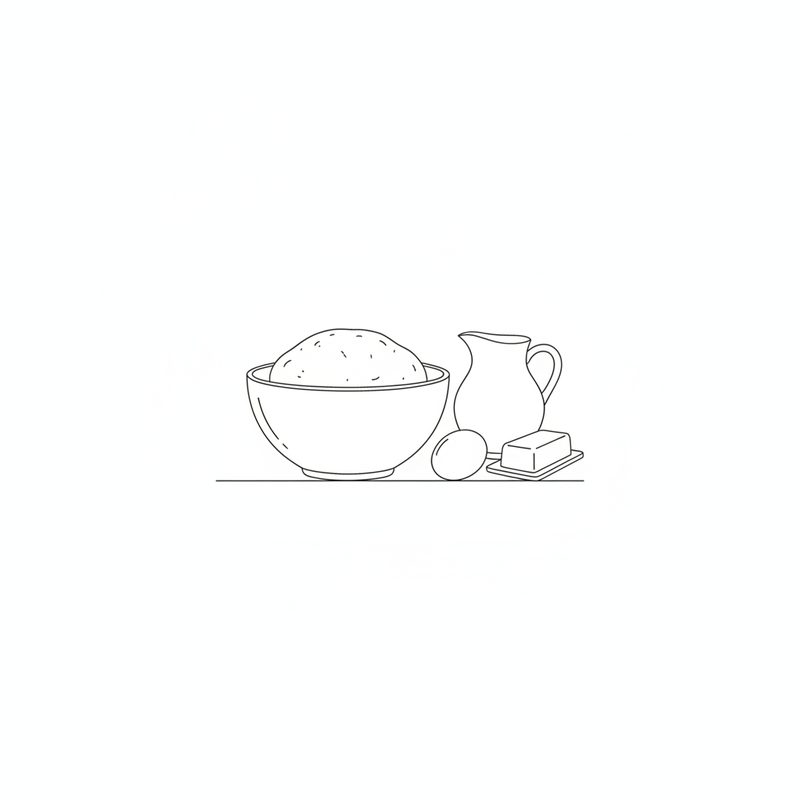
 Mix and knead the yeast dough, then chill it for an hour.
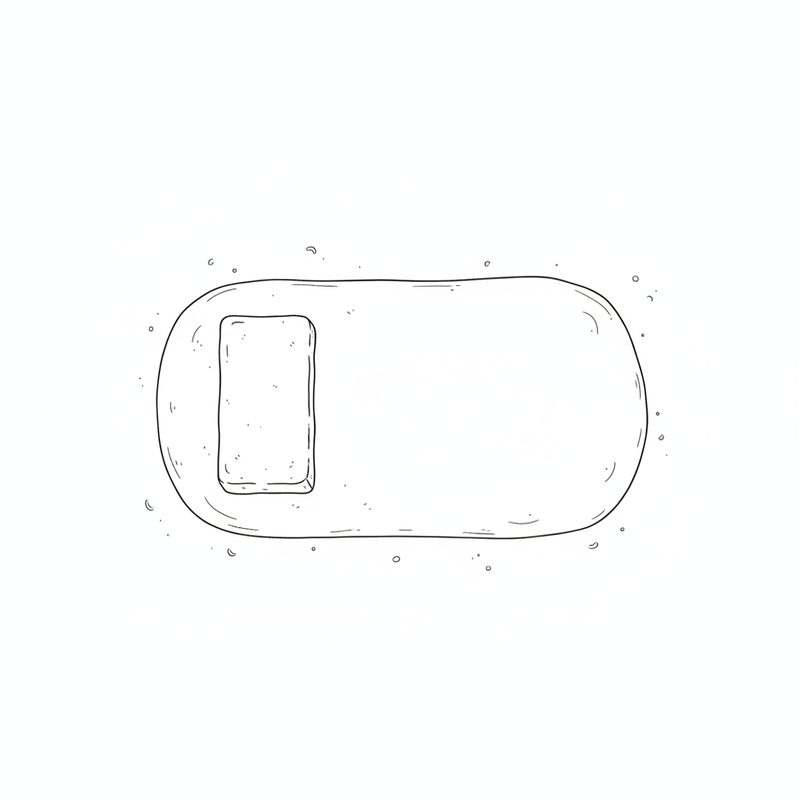
- Close the cold butter inside the dough.
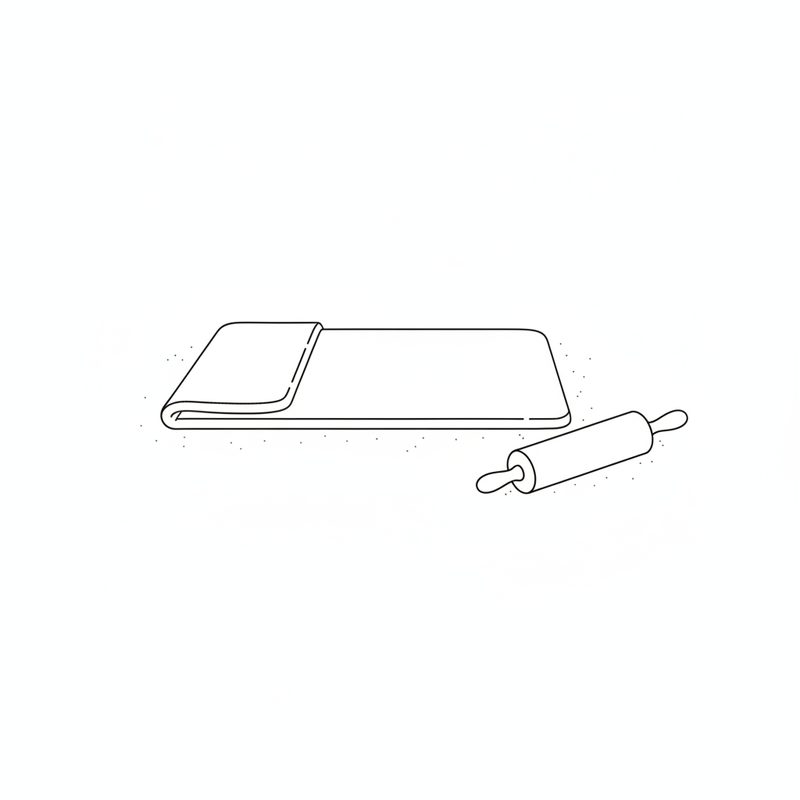
- Roll and fold in three, three times, chilling in between.
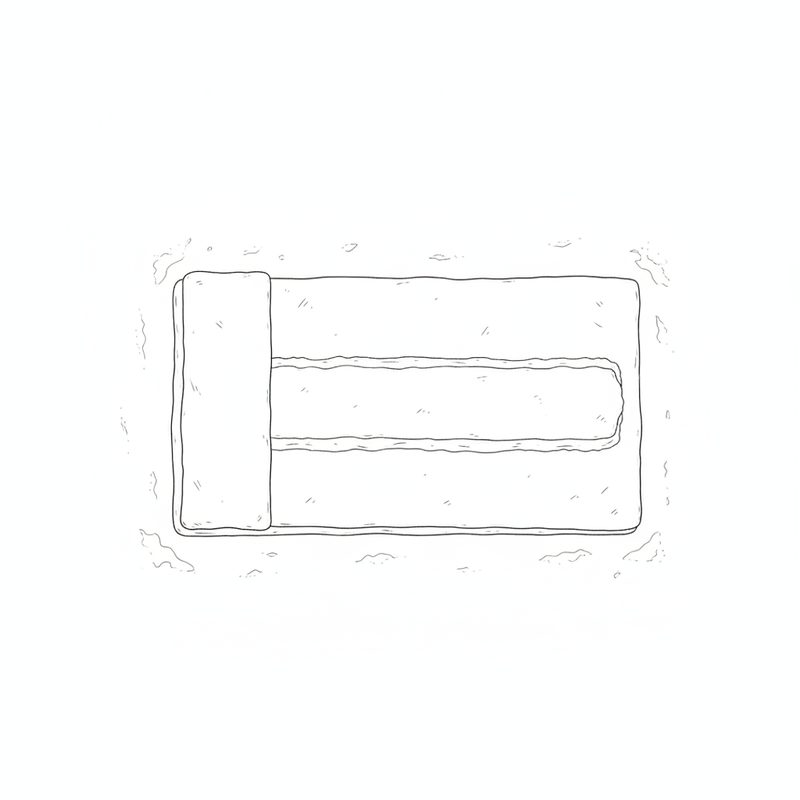
- Spread remonce down the middle third and fold the sides over.
- Brush with egg, cover in poppy seeds and cut into pieces.
- Bake until deep golden and cool on a rack.
Where the numbers come from
Every number on the card comes from a published recipe, chosen by agreement between at least two sources or taken whole from one named source when they did not agree.
| Number | Value | How it was chosen |
|---|---|---|
| Yield | 12 pastries | Skandibaking, Dobbernation and Marie’s Eats all make about 12 (Honest Cooking cuts 15) |
| Remonce | 100 g marzipan, 50 g butter, 50 g sugar | Skandibaking, each number matched by Honest Cooking or Marie’s Eats |
| Poppy seeds | About 20 g (2 tbsp) | Honest Cooking 20 g, Scandinavian Simple Eating 2 tbsp; Dobbernation uses up to 2/3 cup |
| Dough | Dobbernation, whole | Sources disagree on flour and butter, so no figures were mixed |
| Proof | About 2 hours | Skandibaking and Honest Cooking; Dobbernation proofs 30 minutes in the fridge |
| Oven | 220°C (425°F) | Honest Cooking and Dobbernation; Skandibaking bakes at 190°C fan |
| Bake time | 20 minutes | Median of 15 (Skandibaking), 20 (Honest Cooking) and 20 (Dobbernation) |
Prep and total time are left off the card on purpose. The sources give 2½ hours, 3 hours and 12 hours, depending on whether the dough rests overnight, and a single number would be wrong for most kitchens. Dobbernation and Honest Cooking put a same-day bake at 2½ to 3½ hours, most of it chilling and proofing; Skandibaking starts the dough the evening before.
What goes wrong, and what it looks like
Butter pools on the tray. This is the most common failure, and Skandibaking puts it down to under-proofing. Wait until the pastries have roughly doubled and feel light, almost wobbly, when you touch the tray. Proof somewhere cool, not on a radiator, or the butter melts out before the oven sets the layers.
The filling runs out of the ends. The remonce was too thick or spread too close to the edges. Keep it to the middle third and press the overlapping seam firmly, seam side down on the tray. Skandibaking dabs a little water on the dough before folding the second side over, to help it stick.
Dense, bready pastries with no layers. The butter got warm during the folds and blended in. Chill between every fold, and roll gently rather than pressing down hard.
Dark, bitter tops. Poppy seeds scorch. Skandibaking notes that a cooler oven keeps them blue-grey rather than dark; drop to 190°C fan, or follow Dobbernation and lower the oven to 200°C (400°F) after the first 5 minutes.
Serving, storing and freezing
Serve tebirkes warm or at room temperature with coffee, on the day they are baked. The filled version is eaten as it is; the plain Jutland version is split and spread with butter, cheese or jam, as My Danish Kitchen describes. Dobbernation serves them as part of a brunch, with coffee, scrambled eggs and bacon.
They keep for a day in a paper bag, and the tops soften quickly in a sealed box. A few minutes in a hot oven brings back some of the crispness.
To bake them fresh in the morning, freeze them shaped and unbaked, before the final rise, as Honest Cooking does. Take them out the night before and leave them to thaw and rise at room temperature for about 8 hours, then brush with egg, add the poppy seeds and bake as normal.
Questions people ask
What is the name of the Danish pastry with poppy seeds?
It is tebirkes, also called birkes, thebirkes or københavnerbirkes. It is laminated Danish pastry folded around a thin butter, sugar and marzipan filling and covered in poppy seeds.
Is a poppy seed danish the same as a poppy seed roll?
No. A poppy seed danish (tebirkes) is a flaky laminated pastry with poppy seeds on top. A poppy seed roll, such as Polish makowiec, is a soft yeast bread rolled around a thick filling of ground poppy seeds.
What is a traditional Danish pastry?
In Denmark it is called wienerbrød: laminated yeast dough shaped into pastries such as tebirkes, spandauer, kringle and kanelsnegle, usually eaten with coffee in the morning.
Can I make tebirkes with shop-bought puff pastry?
You can make a quick version with puff pastry, but it is a different pastry. Puff pastry has no yeast, so it bakes crisper and flatter, without the soft, bready layers of real tebirkes.
Do tebirkes always have marzipan?
No. The Copenhagen style has remonce, which usually contains marzipan, but some versions use only butter, sugar and vanilla, and in Jutland birkes are often made with no filling at all.
How long do tebirkes keep?
They are best on the day they are baked. Keep leftovers for a day in a paper bag and warm them briefly in the oven; for later, freeze them shaped and unbaked.