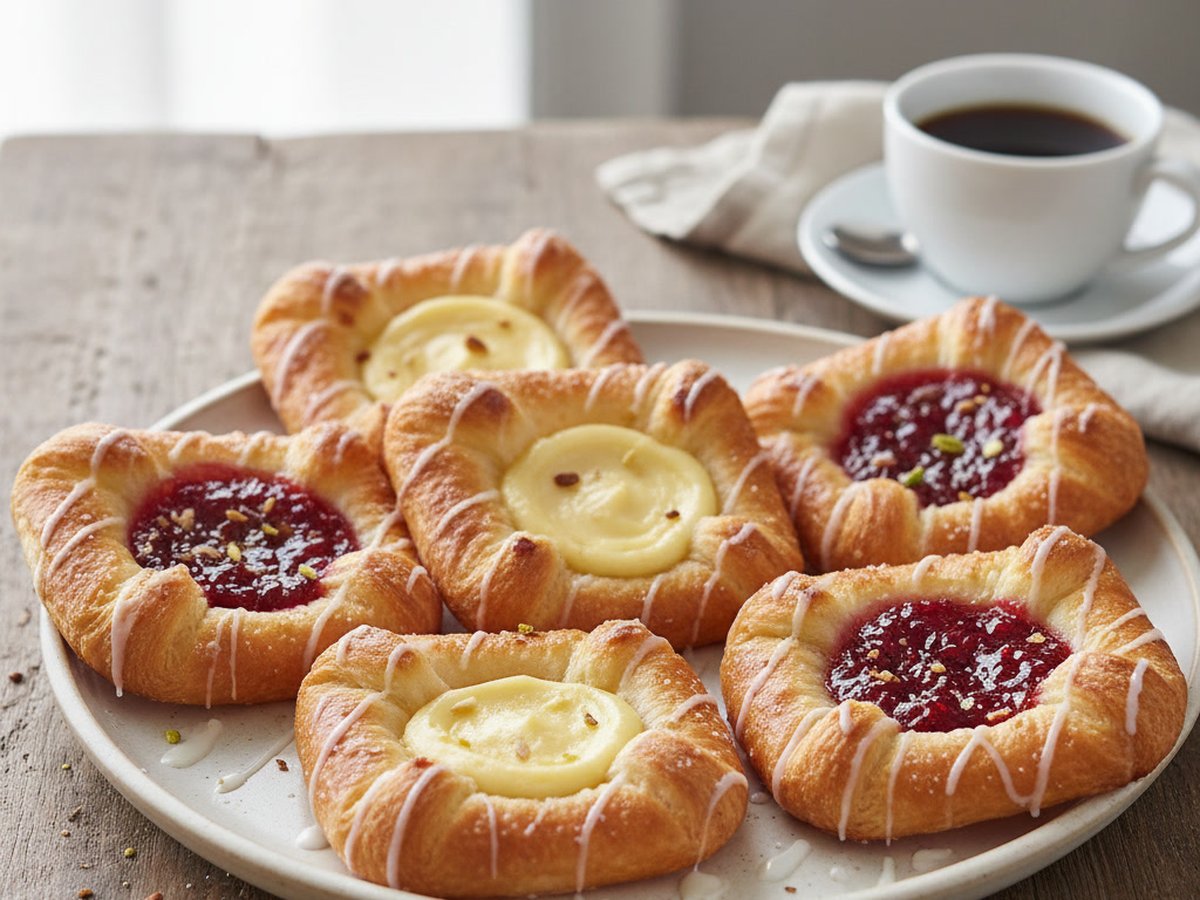
A spandauer (roughly SPAN-dow-er) is a square of Danish pastry dough with its four corners folded over a spoonful of almond remonce, baked with vanilla custard or raspberry jam in the centre and finished with a thin line of icing. It is the most ordinary pastry in a Danish bakery, and it takes a day to make well at home.
The Danish version differs from the American danish in two ways: the dough is laminated with far more butter, and the filling is almond, custard or jam, never cream cheese. This recipe makes 12, and every number on the card comes from published recipes, with the sources named below.
Last updated
Recipe
Spandauer Recipe (Danish Custard Pastries)
Ingredients
Dough (Shipton Mill)
Butter layer
Remonce
Custard (Bake to the Roots)
To finish
Method
- Dissolve the fresh yeast in the lukewarm milk (for dry yeast, whisk it in and leave for about 15 minutes until frothy). Mix in the sugar and softened butter, then add the flour and salt a little at a time, with the egg and yolk halfway through. Knead to a soft, slightly sticky dough. Cover and leave to rise for about 1 hour, until doubled.
- Knead the dough briefly on a floured counter and roll it to a 35 x 35 cm square. Work the 350 g butter and 25 g flour together until the butter is about as soft as the dough, then flatten it between two sheets of baking paper to a 25 x 25 cm square.
- Lay the butter on the dough at a 45-degree angle and fold the dough corners over it until it is fully enclosed, like an envelope.
- Roll the package carefully to about 30 x 50 cm and fold it in three. Cover and chill for 15 minutes. Roll and fold twice more, chilling for 15 minutes each time.
- For the custard, whisk the cornstarch, sugar, salt, vanilla and egg yolk with a few tablespoons of the milk. Bring the rest of the milk and the butter to a boil, whisk in the cornstarch mixture and keep whisking until it thickens. Cover the surface and chill until cold.
- For the remonce, beat the marzipan, butter and sugar together until smooth. Keep it at room temperature.
- Roll the dough out on a floured counter and cut 12 squares of about 10 x 10 cm. Put about 1 tbsp of remonce in the middle of each, fold the four corners in to meet in the centre and press them into the remonce. Place on trays lined with baking paper.
- Cover and leave to rise until puffy and a light press springs back slowly, from 20 minutes (Shipton Mill) to 45 minutes (Sugar Salt Magic). Heat the oven to 200°C (400°F).
- Brush with egg wash, press a hollow into the centre of each pastry and add about 1 tsp of custard or jam. Scatter with nuts if using. Bake for about 20 minutes, until deep golden.
- Cool on a rack. Mix the powdered sugar with the water to a thick icing and drizzle it around the edges.
What is a spandauer?
A spandauer is one of the standard shapes of wienerbrød (VEE-ner-bruhd), the laminated yeast dough Danes use for all their breakfast pastries. A square of dough goes around a small spoonful of remonce, the corners are folded to the middle, and the centre is pressed down and filled after proofing.
Before baking it is a square. In the oven the corners puff and pull back, so the finished pastry looks almost round, with a raised rim around a flat centre. Skandibaking notes you will find several kinds of spandauer in any Danish bakery, and Sugar Salt Magic calls it the most common style of pastry in Denmark.
Why is it called spandauer?
The name comes from Spandau, a district of Berlin. Why a Danish pastry carries it is less certain. Skandibaking, Sugar Salt Magic and Bake to the Roots all repeat the same explanation, each with a “supposedly” or “apparently”: the square shape with four corners and a wall around the centre is said to resemble Spandau prison, which was built square with four towers.
The dough is called wienerbrød, “Vienna bread”, because Austrian bakers are credited with bringing the method to Denmark, and in Germany the same pastries are sold as Kopenhagener Gebäck, according to Bake to the Roots.
How a spandauer differs from an American danish
The dough is the main difference. A Danish wienerbrød dough here carries 350 g of butter folded into 350 g of flour, which gives thin, separate layers rather than a soft, bready pastry.
The filling is the second. The Danish fillings are remonce, custard and jam. Skandibaking says plainly that you will not find a cheese-filled one in Denmark.
The sugar is the third. A spandauer is not glazed all over. The icing goes on in a thin line around the edge, and the centre is left to show the custard or jam.
The dough, and why this one
This recipe uses Shipton Mill’s dough, written by Jan Rasmussen and taken as published. The five doughs found did not agree closely enough to average: flour ranged from 350 g to 500 g, and the butter folded in ran from about half the weight of the flour to slightly more than it. An average of five recipes is a sixth recipe nobody has baked.
Shipton Mill’s dough was chosen because more of its numbers are shared with the others than any other. Its 25 g of fresh yeast matches Sweet Thought, its 50 g of sugar matches Bake to the Roots, its 50 g of soft butter in the dough matches Sweet Thought, and its single egg matches Sugar Salt Magic and Sweet Thought.
Strong bread flour is used because the dough is rolled and folded three times. A stronger dough stretches over the butter without tearing. If you have only plain flour, the dough is softer and needs more care in the rolling.
Fresh yeast can be hard to buy outside Europe. Shipton Mill gives 13 g of active dry yeast as the substitute, proofed in the warm milk for about 15 minutes until frothy.
Remonce, the almond layer you do not see
Remonce (reh-MONG-seh) is butter, sugar and marzipan beaten into a soft paste. It sits under the custard or jam, and it does a practical job as well as adding flavour: it glues the four folded corners down so they do not spring open in the oven.
The amounts here, 100 g marzipan, 50 g butter and 50 g sugar, are the ones at least two of three sources agree on: Skandibaking and Bake to the Roots on the marzipan and butter, Skandibaking and Sweet Thought on the sugar.
Let the marzipan come to room temperature before you beat it. Cold marzipan stays in lumps. The butter should be soft enough to press with a finger, not melted, or the paste turns greasy.
Custard or jam
Both are traditional, and Skandibaking suggests doing half of each. Custard is kagecreme (KAY-eh-kraym), a thick vanilla pastry cream. Jam is almost always raspberry: Skandibaking, Sugar Salt Magic and Bake to the Roots all use it.
The custard here is Bake to the Roots’ recipe, made with 200 ml of milk. That quantity matches the half portion Skandibaking recommends when half the pastries get custard and half get jam. It must be cold and thick before it goes on. A warm, loose custard spreads across the dough in the oven instead of sitting in the hollow.
The amount per pastry is small, about a teaspoon, as in Shipton Mill and Sweet Thought. More than that boils over, and the pastry around it stays pale and damp.
Spandauer, step by step
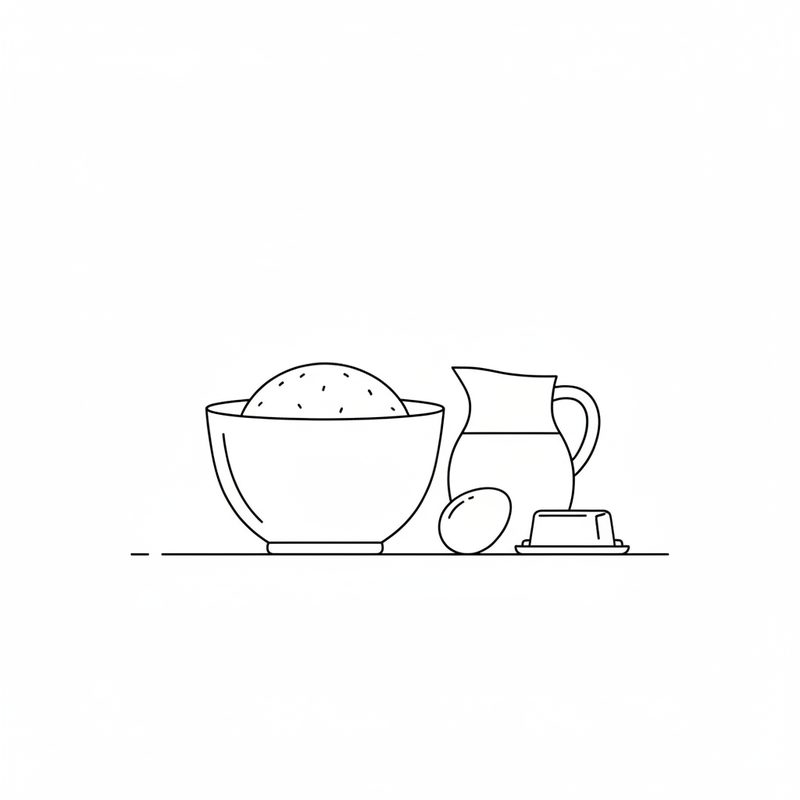
 Mix and knead the yeast dough, then let it rise.
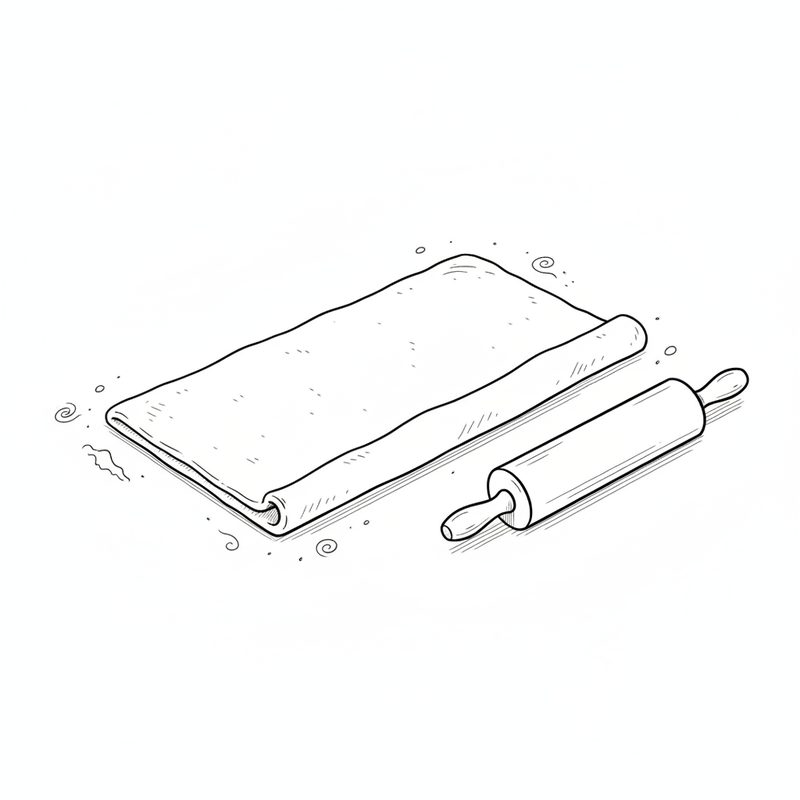
- Close the butter slab inside the dough like an envelope.
- Roll the dough out and fold it in three, three times, chilling between.
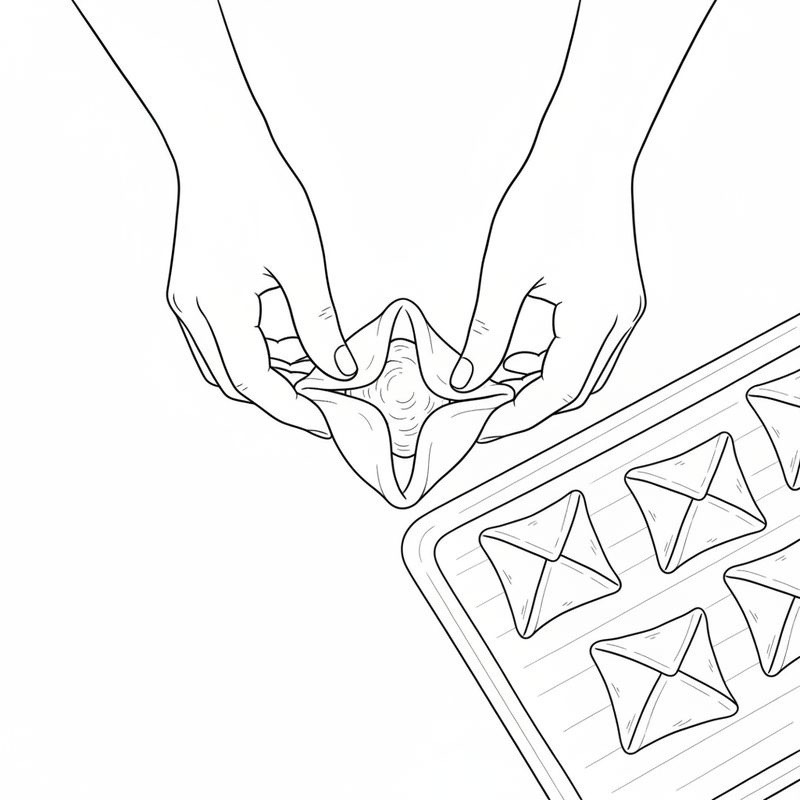
- Fold the four corners into the centre.
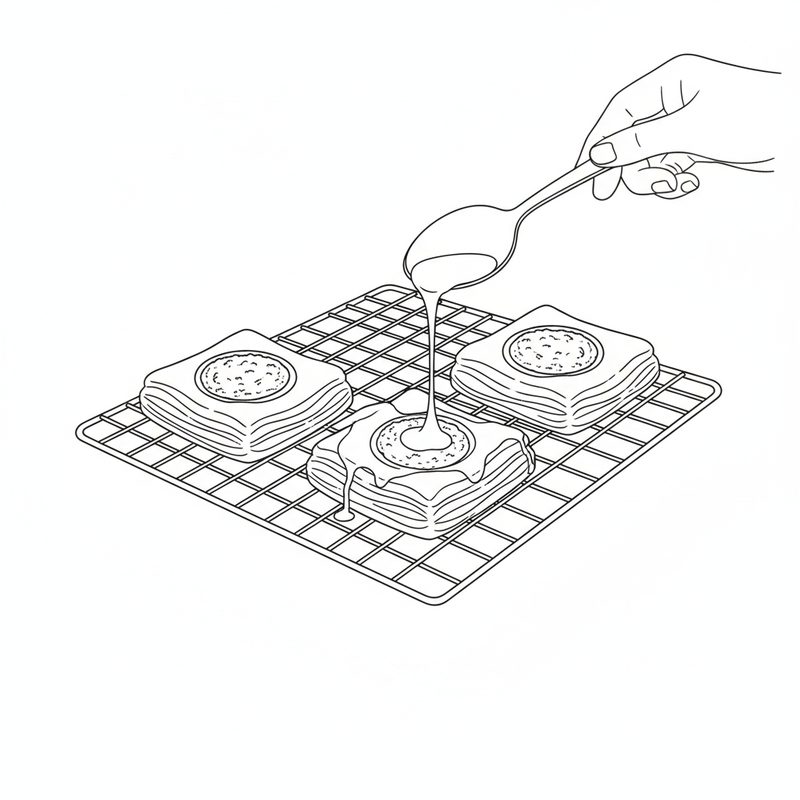
- Egg wash, press a hollow, add custard or jam.
- Bake until deep golden, cool, then drizzle with icing.


Where the numbers come from
Five published recipes were read for this page: Skandibaking, Sugar Salt Magic, Bake to the Roots, Sweet Thought and Shipton Mill. Where they disagree, the card says whose number it uses.
- Makes 12. Skandibaking, Sugar Salt Magic and Bake to the Roots all make 12. Shipton Mill gets 12 to 14 from its dough.
- 10 cm squares. Shipton Mill, Sugar Salt Magic and Sweet Thought all cut squares of about 10 x 10 cm (4 inches).
- Oven 200°C (400°F). Shipton Mill, Sugar Salt Magic and Sweet Thought bake at about 200°C. Skandibaking and Bake to the Roots use 190°C (375°F). Either works; at 190°C expect the longer end of the baking time.
- Baking time 20 minutes. The median of the five: Shipton Mill 10 to 15 minutes, Skandibaking 15 to 20, Sugar Salt Magic 18 to 20, Bake to the Roots 23, Sweet Thought 25 to 30.
- Prep time 1 hour of work. The median of the prep times the recipes state. It does not include the rising and chilling.
- No total time on the card. The recipes that state one run from under 6 hours to 15 hours, depending on whether the dough rests overnight. That is too wide to print as one number. Plan for a long day, or start the dough the evening before.
- Nutrition and ratings are left out. None of the sources measured them, and a guessed number is not information.
What goes wrong, and what it looks like
Butter pools on the tray in the oven. The pastries were under-proofed or the kitchen was too warm when you folded. Skandibaking warns that under-proofing means butter leaking. Proof until the pastries look puffy and a light press springs back slowly.
The butter breaks into pieces under the rolling pin. It was too cold. Shipton Mill says the butter should be about as soft and workable as the dough. Leave it on the counter for a few minutes and try again.
Butter breaks through the dough surface. It was too warm, or the dough was rolled too hard. Dust the spot with flour, as Sweet Thought suggests, and chill the dough for 15 minutes before carrying on.
The corners open in the oven. Not enough remonce underneath, or the corners were not pressed into it. A dab of water on the corners helps them stick.
The centre is pale while the edges are brown. Too much filling. A teaspoon is enough.
Serving, storing and freezing
Spandauer are best on the day they are baked, when the layers are still crisp. Let them cool before icing; the icing melts on hot pastry, and the filling is very hot straight from the oven.
Jam-filled pastries keep for 2 to 3 days in an airtight container at room temperature, according to Sugar Salt Magic, going a little staler each day. Custard is made with milk and egg, so keep custard-filled pastries in the fridge.
To freeze, Nordic Bake Box freezes baked spandauer before icing and keeps them for up to 3 months. Reheat them for a few minutes in a hot oven, then ice.
The same dough family is behind the Danish kringle. For a yeast pastry that asks less of you, try kanelsnegle, the Danish cinnamon snails, or fastelavnsboller in February. More Danish bakery food is in our list of traditional Danish foods.
Questions people ask
Is spandauer difficult to make at home?
It is not difficult, but it is slow. The hard part is the laminated dough: three rounds of rolling and folding with the butter kept cool. Allow most of a day, or make the dough the evening before.
How do you pronounce spandauer?
Roughly SPAN-dow-er, after Spandau, the district of Berlin the pastry is named for.
What is the most famous Danish pastry?
In Denmark, spandauer is a strong candidate. Sugar Salt Magic calls it the most common style of pastry you will find there.
What is a marzipan Danish?
A Danish pastry filled with remonce, a paste of marzipan, butter and sugar. In a spandauer the remonce sits under the custard or jam and holds the folded corners down.
Can you freeze spandauer?
Yes. Nordic Bake Box freezes them baked but not iced, for up to 3 months. Reheat for a few minutes in a hot oven, then add the icing.
Can you use puff pastry instead of Danish dough?
You can shape and fill puff pastry the same way, but it is not a spandauer. Puff pastry has no yeast, so it bakes flat and crisp instead of light and bready between the layers.